
Extruded Concrete vs. Poured Concrete Curbing: What's the Difference?
The Art of Concrete Curbing: Enhancing Your Landscape with Durability and Style
When it comes to improving the look and functionality of your outdoor space, concrete curbing offers a perfect combination of durability, customization, and visual appeal. But what sets our concrete curbing apart? Let’s take a deeper dive into how our process works and why it’s the smart choice for your landscaping needs.
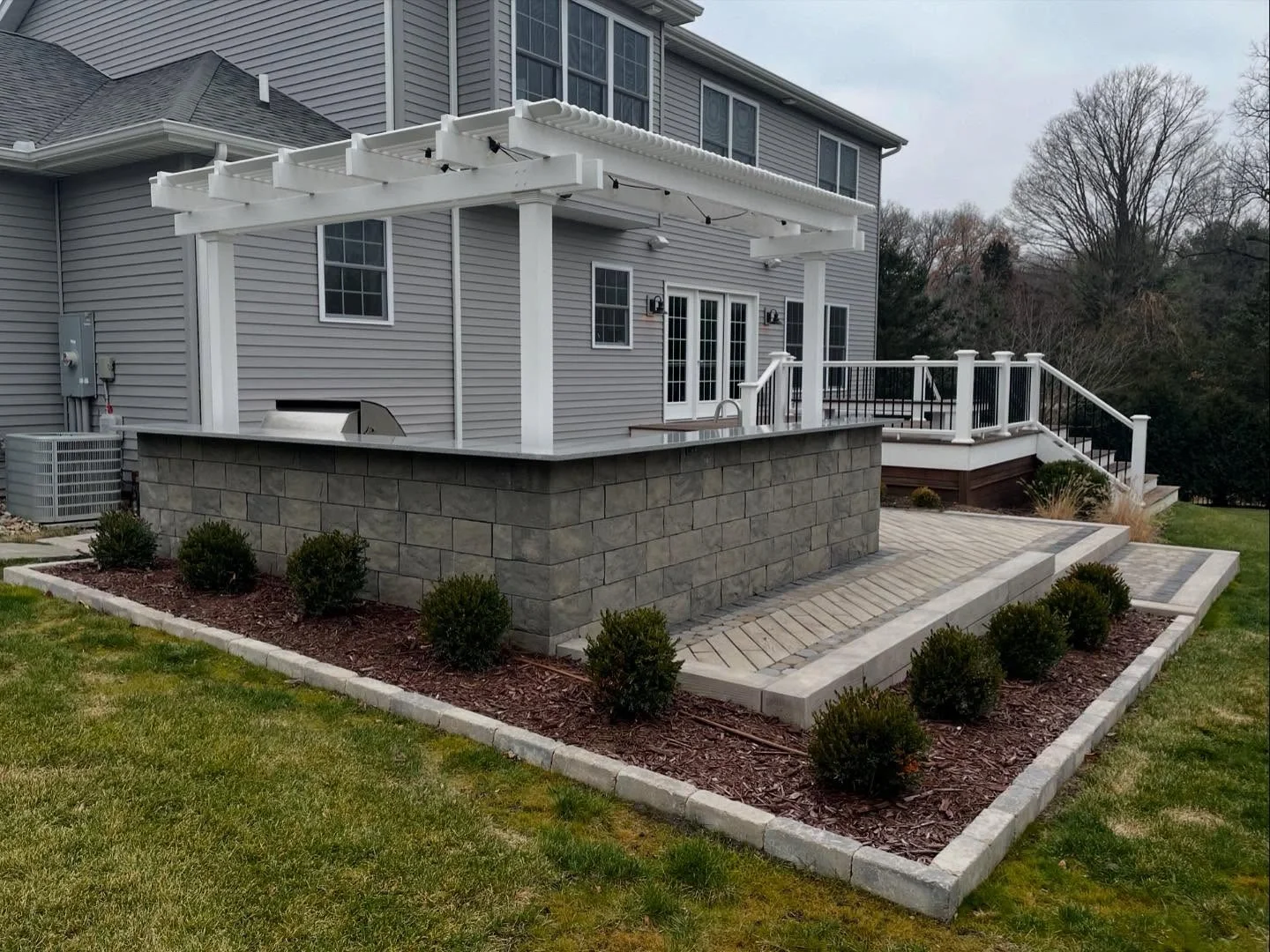
If you've been researching concrete curbing for your yard, you may have come across two different terms — extruded concrete curbing and poured concrete curbing. They're both concrete, but the installation method, the finished result, and the long-term performance are meaningfully different.
Understanding the distinction helps you ask better questions when you're evaluating curbing companies and makes it easier to recognize quality work when you see it.
What Is Poured Concrete Curbing?
Poured concrete curbing is installed by setting forms — temporary molds — along the path where the curbing will go, then pouring concrete into those forms and allowing it to cure. Once the concrete hardens, the forms are removed, leaving the finished curbing in place.
This method is commonly used for larger structural concrete elements like driveway aprons, retaining walls, and sidewalks. It's a proven method for those applications, but it has specific limitations when applied to landscape curbing.
The biggest limitation is joints. Poured concrete curbing installed in forms requires control joints — intentional gaps between sections — to manage the natural expansion and contraction of concrete. These joints create seams in the finished curbing that can become entry points for weeds, areas where sections separate over time, and visual breaks in what should be a continuous border.
Form-based poured curbing is also less flexible in terms of following curves and irregular shapes. The forms need to be set and secured before pouring, which makes complex curves more difficult and time-consuming to execute precisely.
What Is Extruded Concrete Curbing?
Extruded concrete curbing is installed using a specialized machine that continuously mixes and extrudes fresh concrete along the planned path as it moves. The machine shapes the concrete into the chosen profile through a forming head, and the finished curbing is one seamless, uninterrupted piece from start to finish.
There are no forms to set, no sections to pour separately, and no control joints in the finished product. The extruding machine follows the exact contour of the planned path — curves, corners, and all — producing a border that precisely matches the landscape layout.
Because the concrete is mixed fresh and extruded continuously, the crew can also hand-mold texture and detail into the surface while it's still workable, creating stone-look finishes and decorative profiles that aren't possible with form-poured concrete.
How They Compare on Key Performance Factors
Seamlessness is the most significant structural difference. Extruded concrete curbing is one continuous piece with no joints. Poured concrete curbing has seams between sections. In landscape applications where the curbing is exposed to soil movement, those seams are weak points — places where sections can separate, shift, or allow weed growth. Extruded curbing eliminates this vulnerability entirely.
Curve capability strongly favors extruded curbing. The extruding machine follows any path naturally, which means tight curves, irregular bed shapes, and complex multi-feature layouts are all handled smoothly. Form-poured curbing requires custom form work for curves, which increases labor and often produces less precise results.
Surface finish options are broader with extruded curbing. The on-site molding capability allows for stone textures, decorative profiles, and custom finishes that aren't practical with form poured concrete. Poured concrete is typically smooth or broom-finished — serviceable, but limited compared to what extrusion allows.
Installation speed is significantly faster with extruded curbing. The machine moves continuously along the path, laying the entire border in one pass. Form work for poured curbing requires setting, securing, pouring, curing, and stripping — a multi-step process that takes considerably longer for the same linear footage.
Reinforcement is achievable with both methods, but the stainless steel cable reinforcement used in professional extruded curbing installations is particularly effective because it runs continuously through the entire length of the border. In sectional poured curbing, reinforcement is limited to each individual section.
Why Extruded Concrete Curbing Is the Professional Standard
For residential and commercial landscape curbing applications, extruded concrete curbing is the professional standard for good reason. The seamless installation, superior curve capability, broader design options, faster completion, and continuous reinforcement capability all make it the better product for the application.
J&J Custom Curbing installs all landscape curbing using the extruded method — which is why every installation is one continuous, seamless border with no joints, no sections, and no weak points. Combined with stainless steel cable reinforcement and fiber-enhanced concrete cured to 3,000 PSI, the finished product is backed by a 5-year warranty that reflects confidence in both the method and the materials.

Ready to see what professional extruded concrete curbing looks like in your yard? J&J Custom Curbing serves homeowners and commercial properties across the Dallas-Fort Worth Metroplex.


.svg)
.svg)
.svg)